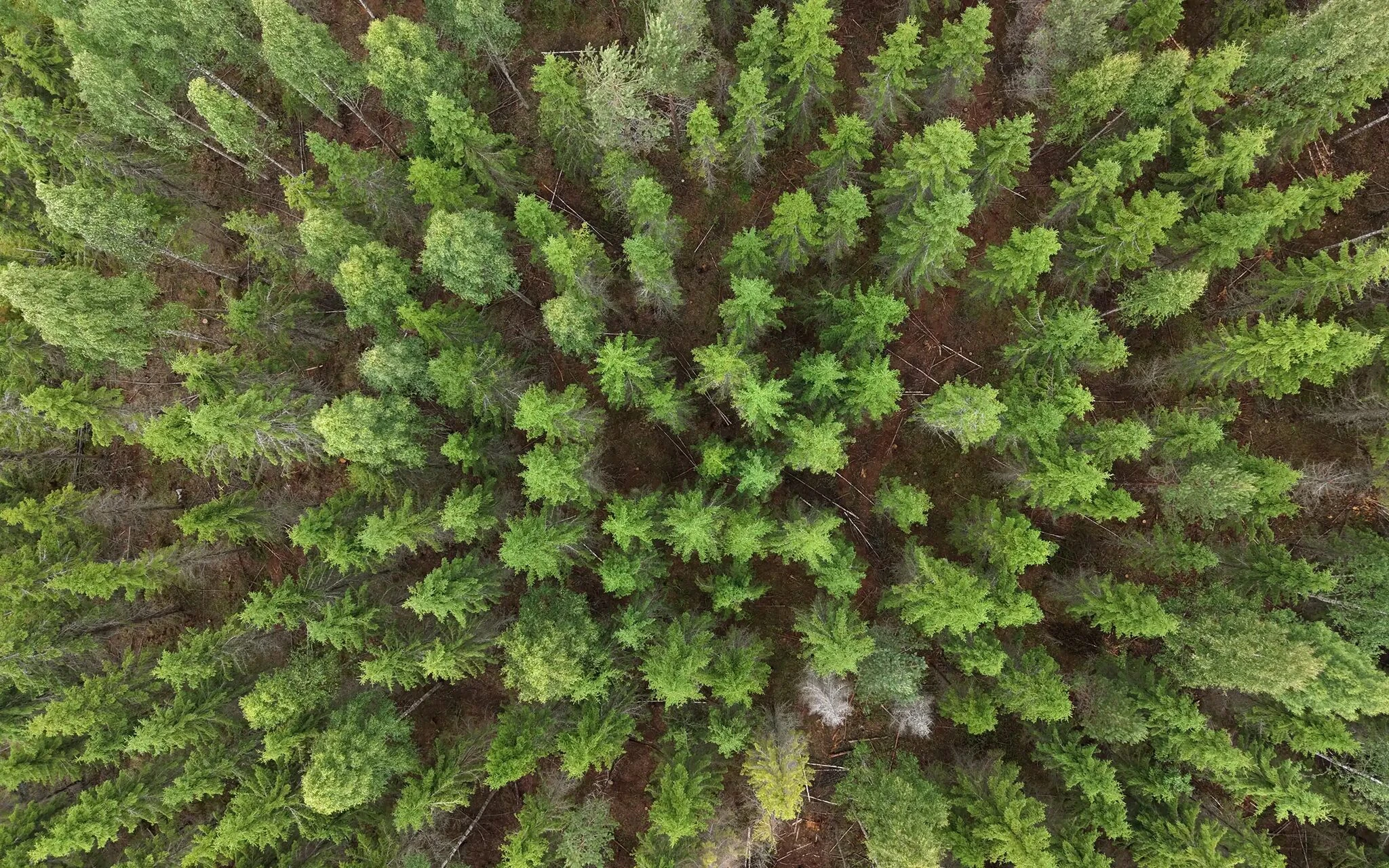
In narrow-trail harvesting (pienuratekniikka), the first thinning is carried out with a compact forest machine along narrow trails – roughly 2.5–3 metres wide, spaced about 10 metres apart. No permanent strip roads are opened at all, so the entire growing area remains in productive use. The name is Finnish: pienura means "small trail".
How does narrow-trail harvesting work?
In conventional mechanized harvesting, the first thinning is when a permanent strip-road network is opened for the whole rotation period. Under current Finnish guidance, this means roads at least 4.5 metres wide, spaced about 20 metres apart. The trees removed for those roads never return to production.
Pienuratekniikka takes a different route. After first thinning, the remaining crop trees stand 2.5–3 metres apart, and a compact forest machine is only 1.65 metres wide. The machine fits between the growing trees. The trails run roughly 10 metres apart, a spacing that follows directly from the crane's reach of just over five metres, so every tree on the stand can be worked from the trails.
Both felling and forwarding use the same narrow trails, with machines of the same size class. This is a condition of the method: if the trails must be widened to fit larger forwarding equipment, the core idea of the method is lost.
Why are strip roads a problem for wood production?
The ground under strip roads is out of production precisely when the forest is building value. The phase between the first and second thinning is the economically most valuable growth period of the stand. When that area stays productive, second-thinning yield rises and total wood production per hectare increases over the whole rotation period. Faster-growing stands also sequester more carbon.
Narrow trails and lightweight machines also leave only a light footprint. Soil damage – and root damage in particular – remains remarkably low. The forest is also considerably more pleasant to look at, and a joy to walk into.
What happens at the second thinning?
Strip roads for larger machines are opened only at the second thinning, if they are needed at all. Because the trees that would have been removed for roads have had time to grow, the harvest volume is larger. By then, the narrow trails have often closed over so completely that they can no longer be seen in the stand. Some compact harvesters can handle log-sized trees, so even the second thinning can be done with the same method.
What machinery does narrow-trail harvesting require?
The method calls for machines that are narrow, light, and long-reaching relative to their size. The compact forest machine used in current research, the Alstor 850H harvester, is 1.65 metres wide, weighs about 4,000 kg, and has a crane reach of 5.2 metres. The same base machine works as both harvester and forwarder. Young-stand improvement can be done with a corresponding machine fitted with an accumulating energy-wood head. Compact machinery also means lower operating costs – and markedly lower relocation costs between sites.
Where does narrow-trail harvesting fit?
The method was developed for first thinnings. It also offers an answer to worsening harvesting conditions and to sites where heavy machinery cannot operate.