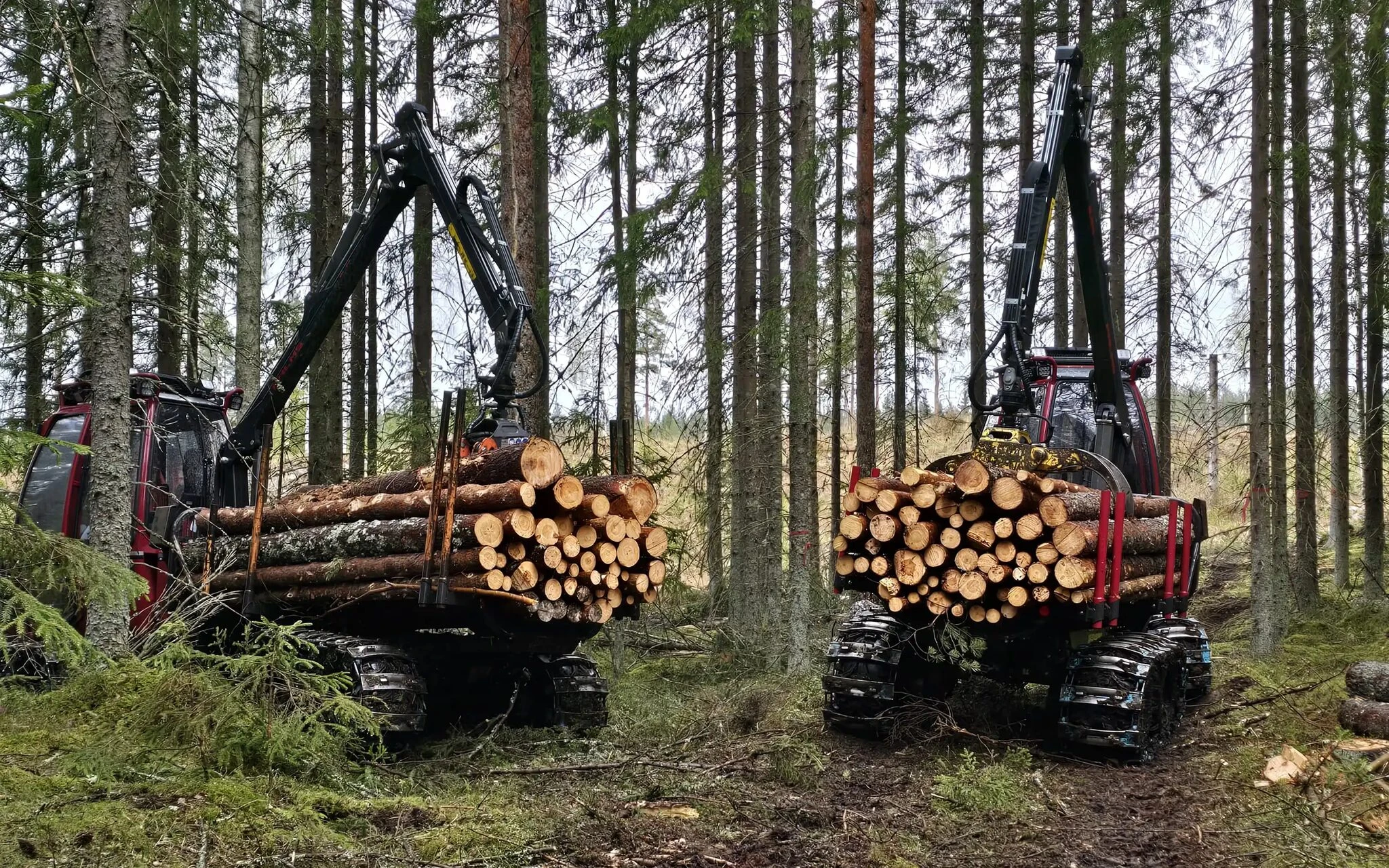
The key advantage of compact machinery is not just size but flexibility. Road width and spacing can be chosen per site and per stand, instead of one standard solution dictating everything.
Four basic configurations
With compact forest machines, a thinning can be organised in at least four ways:
-
20-metre strip-road spacing with one cutting trail between the roads.
Closest to established practice. The cutting trail is a narrow trail used only by the harvester. -
30-metre strip-road spacing with two cutting trails between the roads. The harvester works from so-called ghost trails – narrow trails that are not used for forwarding and that blend back into the stand. This restores the actual strip-road spacing to the 30 metres used in the 1970s.
-
10–15-metre trail spacing without cutting trails. The basic form of pienuratekniikka: all trails are narrow. The roughly 10-metre spacing follows directly from the crane's reach of just over five metres. When the harvester and forwarder are in the same size class, every trail can also be used for forwarding.
-
Trail-less felling without established trails. No fixed trail network at all, so in principle every gap between trees is a potential route. Strongest with a heavy single-thinning removal, which leaves wide spacing between the remaining trees.
How does the next thinning affect the choice?
The trail decision spans the whole rotation period, and its consequences surface at the next harvest.
With dense narrow trails (10–15 m), the basal area of the growing stock stays at roughly the same level as with 20-metre spacing. The trees are simply distributed more evenly. At the second thinning, roads for larger machines are opened only then, harvesting full-grown trees in the process.
With widened 30-metre spacing, the challenge arrives at the next round, as larger harvesters cannot work at 30-metre spacing without cutting spur trails into the stand. The road network must often be rebuilt entirely, perpendicular to the old one. On the other hand, the harvesters of today's compact forest machines can handle log-sized trees. The second thinning can then be done with the same machinery, leaving only the final late thinnings and regeneration fellings to heavy equipment.
An old road network can also be an asset. If the first thinning was once done with narrow roads at, say, 30-metre spacing, harvesting can continue on the same network without widening. A narrow harvester on the ghost trails, a narrow forwarder on the strip roads.
Machine combinations
Felling and forwarding do not require the same machine, and several combinations work:
-
Compact harvester + compact forwarder
The basic pienuratekniikka pairing, with the whole network in shared use. -
Compact harvester + mid-size forwarder
Felling on narrow trails, forwarding on a sparser and wider road network. -
Full-size harvester minimising road width + compact forwarder
An option particularly for continuous-cover silviculture, where removing large overstorey trees demands capability and mass from the harvester. -
Manual chainsaw work + compact forwarder
Felling without machine trails; forwarding with narrow machinery without established strip roads.
A note on size classes: even slight curvature in narrow trails rules out agricultural-tractor-based forwarding equipment. If trails are widened to fit the forwarding machinery, the core idea of the method is lost. The forwarding equipment must be chosen to fit the trails, not the other way around.
Planted forests and row spacing
In planted forests, the narrowest machines operate between the planting rows without removing a row. Mid-size machinery requires removing at least one tree row to form a road, and roads must locally be widened so that the extra-wide bogie tracks used for flotation do not damage roots.
Road width and roadside density
Two rules of thumb help in planning the roads.
Leave the stand denser along a wide road. A tree at the road's edge gets light and space from the road side, so it needs less room on its other sides. Trees along the road can therefore grow closer together, almost in a row. A tree does not need a circular growing space.
A road does not remove its full width from production. The crowns of roadside trees spread over the road and use its light and space. On a road roughly 4 metres wide, the true growth loss is only about 1.5–2 metres measured from the centre line.
In summary: the choice is made at the stand
The right trail solution depends largely on the stand: its trees, its soil, the silvicultural goal, and the machinery intended for the next harvest.