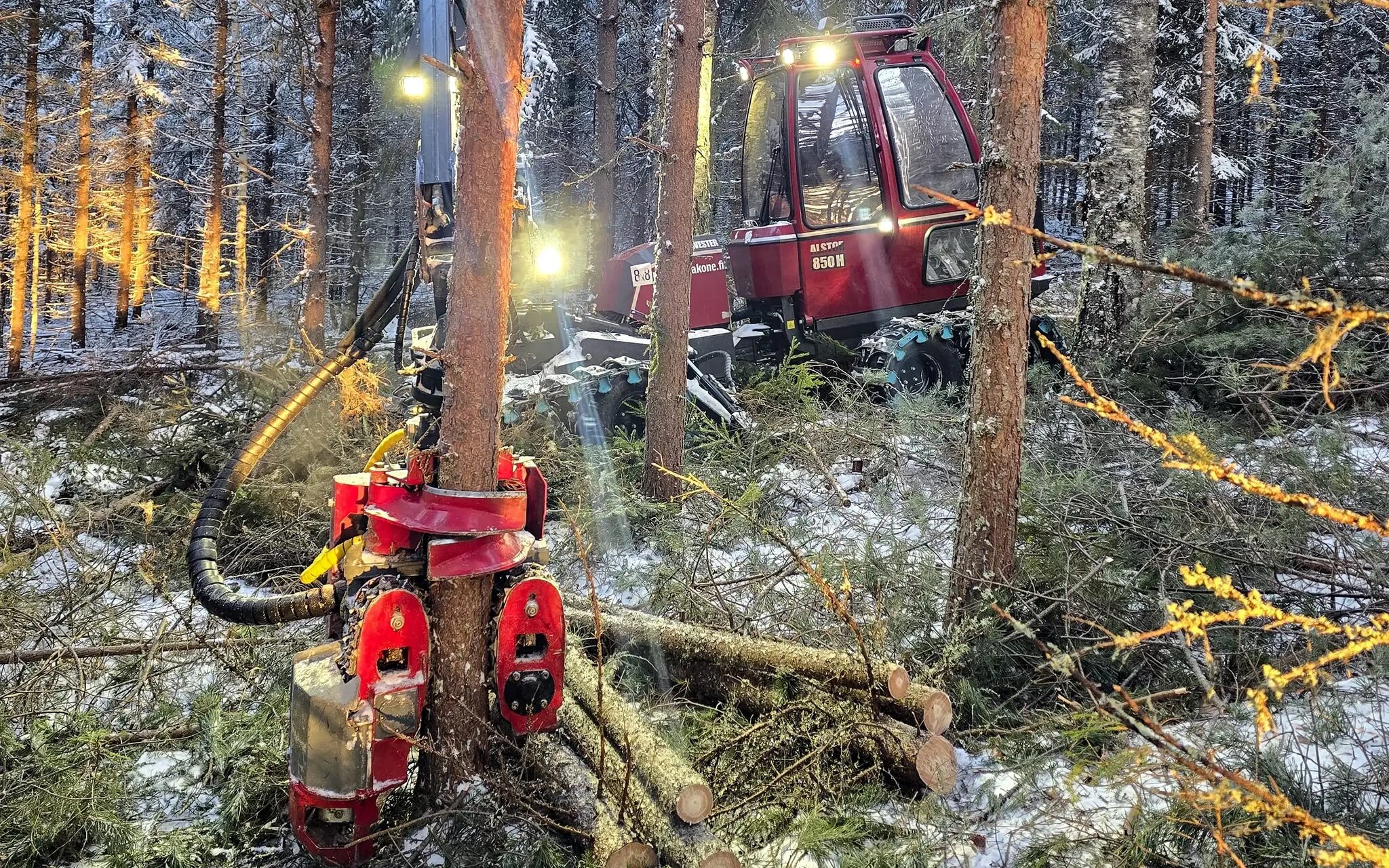
The benefit of pienuratekniikka is not a single advantage but a chain, where each step follows from the previous one. When no growing area is lost, growth is directed into the crop trees, and the gain is realised at the following harvests.
How much growing area do strip roads take?
Under the harvesting-quality criteria of the Finnish forest management recommendations, strip roads in intermediate fellings must be spaced more than 19 metres apart, with a road width below 4.6 metres on mineral soils (below 5.1 metres on peatlands) [Source: Metsänhoidon suositukset (Finnish forest management recommendations), Tapio 2026]. In practical harvest planning, the working guideline is roughly 20-metre spacing and a width of at least 4.5 metres. These roads are opened at the first thinning for the entire rotation period, so the trees removed to make way for them never return to production.
A road's true growth loss is, however, smaller than its nominal width, as trees along the road extend their crowns into the open space. For a 4-metre road, the real growing-area effect is roughly 1.5–2 metres from its centre line. But the loss is permanent, and it repeats along every road across the whole stand.
How does pienuratekniikka avoid the loss?
In pienuratekniikka, the first thinning is carried out along trails 2.5–3 metres wide, spaced roughly 10 metres apart. According to preliminary research observations, trails this narrow have only a very small effect on the remaining stand. By the time of the next thinning, the narrow trails have often closed over so completely that they can no longer be seen.
Where does the economic gain come from?
The phase between the first and second thinning is the economically most valuable growth period of the stand. When that growth is not left on ground lost under permanent strip roads, all of it is directed into the crop trees. At the second thinning the gain is realised in two ways: the crop trees are larger, and there are more of them.
Only at the second thinning are strip roads opened, yielding full-grown trees from the road lines – instead of the same trees having been cut small at first thinning. Second-thinning yield rises, and total wood production per hectare increases over the whole rotation period.
How much fuel does pienuratekniikka save?
The fuel difference is visible already – and it has been measured. According to ErkkaTec Oy's machine-tracking data, the Alstor harvester consumes on average 3 litres per hour and the forwarder 2 litres per hour. The corresponding figures for a full-size machine chain are roughly 13–17 and 9–13 litres per hour (puuhuolto.fi, energy-efficiency guide).
What matters, however, is consumption per harvested cubic metre, since a smaller machine harvests more slowly. At the tracked productivity (harvester 4.1 m³/h, forwarder 6.3 m³/h), the compact chain consumes about 1 litre per cubic metre. A full-size chain averages about 3.2 l/m³ in first thinning – roughly three times as much. At the current fuel price the difference is in the order of €4/m³ (8/2026) in the compact chain's favour, and if fuel prices rise, the difference grows in the same proportion.
Fuel is naturally only one part of total harvesting cost. But it says something essential: a compact forest machine does the first thinning with an amount of energy sized sensibly for first-thinning trees. The same shows on the environmental side, as less fuel per cubic metre means lower harvesting emissions per cubic metre.
What other benefits does the method have?
Lightweight machinery and narrow trails keep soil damage – and root damage in particular – remarkably low, reducing decay risk and growth losses.
Smaller machines also mean lower operating costs and markedly lower relocation costs, which improves the economics of smaller stands.
Faster-growing stands sequester more carbon.
What do wide strip roads do to wind and sun?
A strip road at least 4.5 metres wide and typically straight is a corridor through the forest, along which wind can blow unobstructed. This is recognised in harvest planning: guidance recommends orienting strip roads against the prevailing winds precisely because of windthrow risk. Heavy thinning increases the risk of wind damage in any case (Finnish forest management recommendations, Tapio 2026), and a permanent road network keeps the wind corridors open for the whole rotation period.
The same corridor also lets sunlight beat straight down onto the ground, as the even canopy shade is missing along the road line. According to an expert assessment, together with the wind this can increase soil drying on and beside the road, and change the forest's microclimate around it. The effect may become more pronounced if drought and wind increase with climate change, as the record-dry spells of recent summers have reminded us.
The narrow 2.5-3 metre trails of pienuratekniikka do not form comparable corridors. The canopy reaches over a narrow trail, the trails curve with the trees, and they close over by the next thinning. To be clear: thinning itself improves the drought tolerance of the remaining stand (Finnish forest management recommendations, Tapio 2026). The question is not the thinning, but what kind of openings are left in the forest permanently.
Which forest would you rather walk in?
The beauty of a forest is less a matter of taste than often assumed – it has been studied in Finland for decades. According to the research, Finns value a managed forest with good visibility, and thinning itself generally increases the appreciation of a forest landscape. But the research also shows the other side: a harvest lowers scenic value at first, and appreciation recovers only once the harvesting marks disappear (Silvennoinen 2013; Miina et al. 2020).
For the landscape, what matters is how long the marks remain visible.
With pienuratekniikka, the marks disappear quickly. The narrow trails close over, soil and root damage stays low, and within a few years a visitor sees a thinned forest, not a harvesting site. What remains is what the research says people like: a light, managed forest that is easy to move through.
A permanent strip-road network, by contrast, stays visible – as its name says, permanently. You can verify this yourself from aerial imagery: open the satellite view of any map service and look at thinned forests anywhere in Finland. The strip roads draw themselves across the stands as repeating stripes, still distinguishable even decades later. The same striping is visible on the ground, to anyone walking the forest, for the whole rotation period.
For a forest owner this is no side issue. In surveys, the beauty and recreational value of forests are felt to be as important as economic security, and about half of forest owners consider it important that harvests also improve landscape values (Järvinen et al. 2006; Hyvönen 2010).
Who should run these numbers?
If you own a stand approaching first thinning, the comparison is worth making over the rotation period – not as the cost of a single harvest.
Sources for this page:
Metsänhoidon suositukset (Finnish forest management recommendations), Tapio 2026 (CC BY 4.0), metsanhoidonsuositukset.fi. Available in Finnish and Swedish.
Energy-efficiency guide (Energiatehokkuusopas), puuhuolto.fi (in Finnish).
ErkkaTec Oy, machine-tracking data, pihapuutpinoon.fi (2026)
Silvennoinen H. (2013), Dissertationes Forestales 242 · Miina et al. (2020), Metsätieteen aikakauskirja.