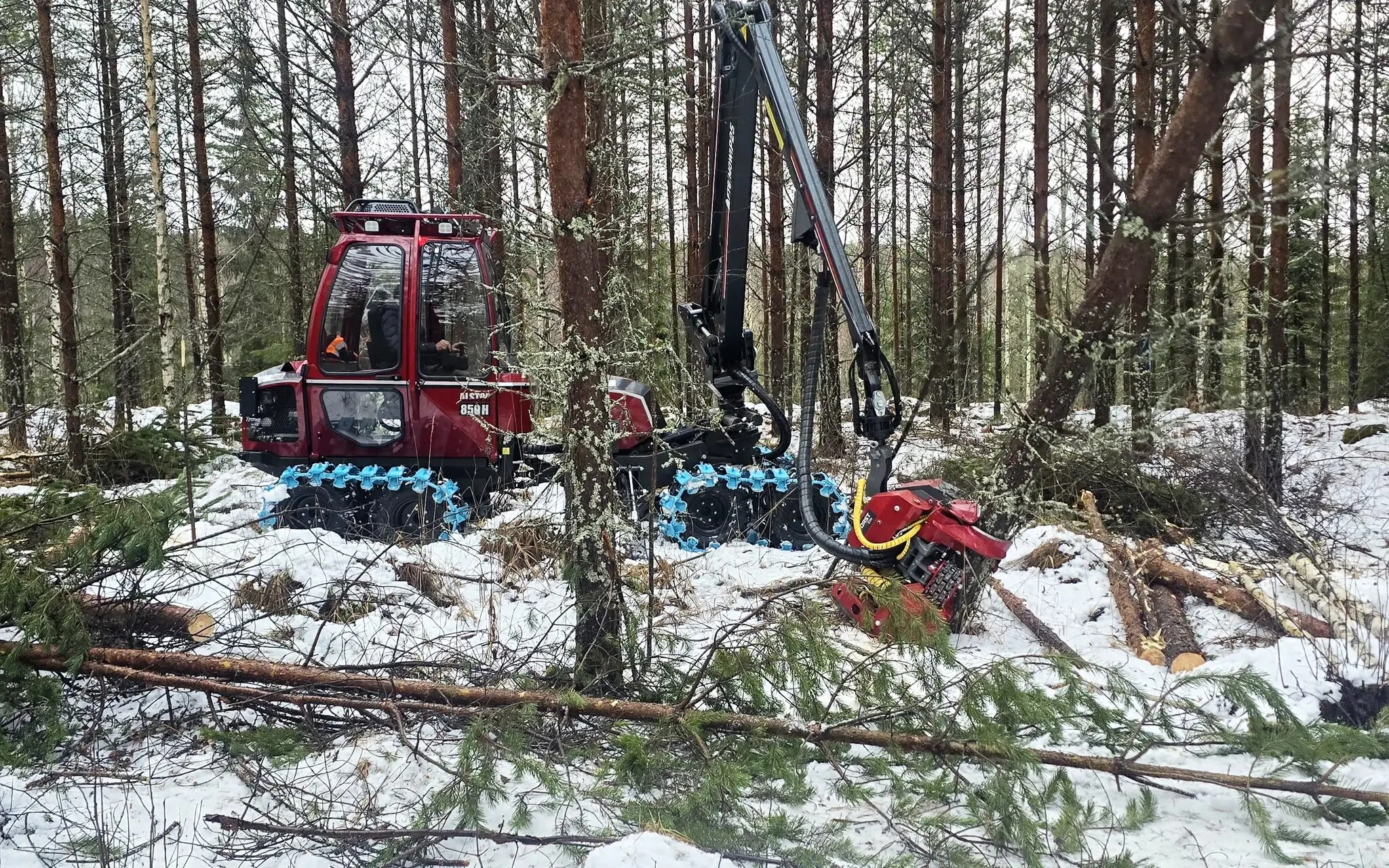
The machine used in pienuratekniikka is the compact forest machine (in Finnish, pienmetsäkone): a narrow, lightweight forest machine with long reach for its size, moving between the crop trees. The method sets three conditions for the machine.
Narrow build
After first thinning, the crop trees stand 2.5–3 metres apart. The machine must fit through that gap without widening the trails. In practice, this means a width well under two metres.Low weight
A light machine leaves a light footprint, keeping soil and root damage low. A compact forest machine moves easily on soft-soil sites where heavy equipment cannot operate. Weight also shows in fuel costs: a lighter machine moves less mass, so it inherently consumes less. In addition, relocations between sites are markedly cheaper.Reach matched to trail spacing
The crane's reach defines the trail spacing. With a boom of just over five metres, trails sit roughly 10 metres apart and every tree can be worked from them. Reach, narrowness and stability have to be engineered together. A narrow machine needs the stabilisation of support legs, so that a long boom under load does not tip it.
Compact forest machines on the market
All three conditions together are a demanding combination. Many machines marketed as small are, at the end of the day, too wide to pass through a 2.5–3 metre gap between trees. In practice, the narrowest size class offering both harvester and forwarder versions within one model family is currently covered only by the machine range of Alstor of Sweden. For this reason it has been the primary machinery in research on pienuratekniikka.
The Alstor 850H used in the research
The Alstor 850H is 4.5 m long and 1.65 m wide, with a service weight of about 4,000 kg including 920 kg of removable counterweights. The crane is a Mowi P25 with a 5.2-metre reach. The manufacturer describes its machine class as stand-going, meaning the machine advances between the growing trees without opening separate strip roads. Pienuratekniikka is built on this same idea.
The harvester head on the 850H is the roller-fed Keto-Forst Eco (305 kg), whose higher feed speed raises productivity on easily delimbed stems. The alternative is the stroke-fed Tapio 170 (240 kg), one of the lightest heads on the market and the stronger choice for thick-branched broadleaves (Koneviesti 1/2026). Current configurations and availability are best checked with the importer.
One size class for the whole machine chain
A condition of the method is that forwarding is also done with machinery of the same size class. The strip roads are then dimensioned by the harvester, not by the forwarding equipment. The same Alstor model family includes both harvester and forwarder versions, so the entire chain runs on the same trails. The forwarder used in the research carried a load of roughly three solid cubic metres.
Other work with the same base machine
The same base machine adapts to several jobs. Young-stand improvement can be done with an accumulating energy-wood head. Combi models, in turn, both fell and forward. For a smaller forest holding, this can mean one machine instead of several.
Where to find the machines?
In Finland, sales, development and service of Alstor compact forest machines are handled by pienmetsakone.fi. International availability: Alstor of Sweden, alstor.se.