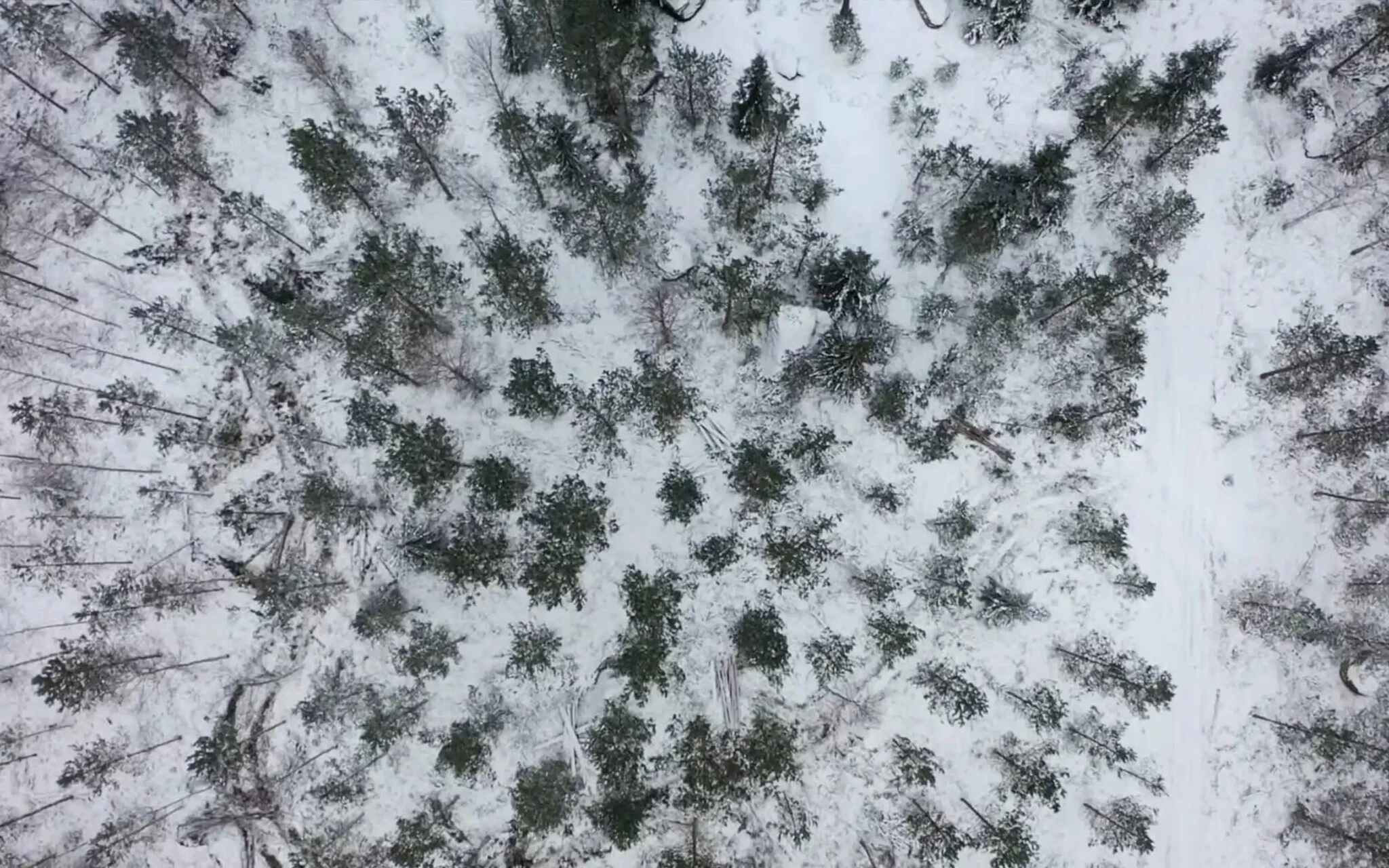
Stands approaching first thinning
The method was developed for first thinnings, where its benefit is greatest: opening permanent strip roads can be postponed entirely to the second thinning, so no growing area is lost during the stand's most valuable growth phase. The economics are worked through on their own page.
Sensitive and soft-soil sites
Harvesting conditions will keep getting harder: milder winters shorten the frozen-ground season, and a growing number of sites are too soft for heavy machinery. A lightweight compact forest machine of around 4,000 kg can operate where a machine many times heavier cannot. A more compact machine also leaves remarkably little soil and root damage behind. This makes the method a genuine option for sites where harvesting has been postponed because of ground conditions.
Small and awkward stands
Relocating compact machinery between sites costs markedly less than moving heavy equipment. A stand that is too small to be economically viable for a full-size machine chain can be a perfectly profitable site for compact machinery.
Continuous-cover silviculture and special sites
In continuous-cover forests, compact machinery offers options a heavy chain cannot. Felling can also be done as manual chainsaw work, with forwarding handled by a small forwarder without established strip roads. In planted forests, the narrowest machines fit between the planting rows, so no tree row needs to be removed to open a road.
What about the second thinning?
Compact forest machines can handle log-sized trees, so the method's use does not necessarily end at first thinning. Heavier late thinnings and regeneration fellings remain work for larger machinery in any case.
When is pienuratekniikka not the right choice?
In snowy winters, using smaller-wheeled machinery is more challenging, as the harvester must advance through untouched snow. In such periods the method's efficiency suffers.
The method also requires that the entire chain, from felling to forwarding, uses compact machinery. If the trails must be widened to accommodate larger forwarding equipment, the core idea of the method is lost. And if a stand has already been thinned with a wide strip-road network, the greatest benefit is already gone, though an existing network can often be reused with compact machines without widening the roads.
Where to go from here?
If pienuratekniikka might suit your stand, or you want to keep your forest tidy and visually pleasing, the next step is practical: the companies working with the method are listed on Narrow-trail harvesting providers in Finland.